


I once spent forty minutes writing a post and about eight seconds naming it. “How to Improve Your Onboarding Emails.” Published it, watched it sit at the bottom of my traffic report for two months, then rewrote the exact same title as “Your Onboarding Emails Are Losing You Customers in the First 48 Hours.” Same content. Same word count. Traffic tripled in six weeks.
That’s the whole argument for taking titles seriously, right there in one dumb personal example.
Most people treat the headline as the last five minutes of the writing process. It’s actually closer to being the first impression, the pitch, and the search-ranking signal all at once. And if you’re already using AI to draft content, there’s no reason to wing the headline — you just have to ask better questions than “give me some title ideas.”
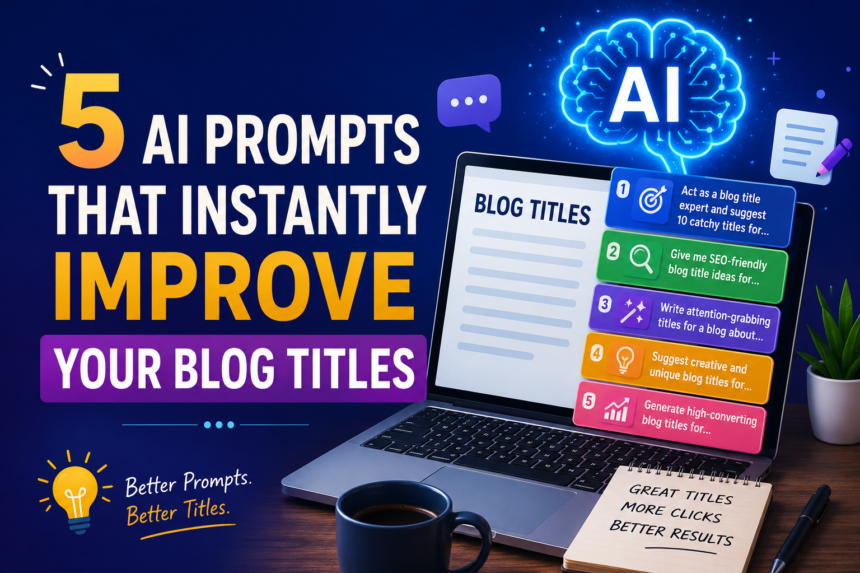
Below are five prompts I keep saved in a note on my phone, because I use them enough that retyping them each time got annoying. I’ll walk through why each one works and where people usually mess it up.
Why the Generic Prompt Fails You
Quick detour first. If you’ve typed something like “write 10 titles for this blog post” into ChatGPT and gotten back a wall of near-identical options, that’s not the model being dumb — it’s the prompt being lazy.
An AI can’t guess who your reader is, what they’re already frustrated about, or what tone your brand uses unless you feed it that context. Skip that step and you get titles that could belong to literally any blog on the internet. I’ve seen this happen with agency teams generating content for five different clients using one copy-pasted prompt — the titles all sound identical because nothing in the prompt differentiated the audiences.
Prompt 1: The Reader Objection Prompt
This forces the model to think like your skeptical reader instead of a copywriter trying to sound clever.
The prompt: “Here’s my blog post topic: [topic]. Write 8 title options that each address a specific doubt, fear, or objection my reader might have before clicking. Avoid generic superlatives like ‘best’ or ‘ultimate.’ Make each title concrete and specific to the outcome, not the topic.”
Most weak titles describe the topic. “A Guide to Email Marketing.” Nobody clicks on a topic. They click on something that names a problem they’re already having at 11pm, alone with their laptop and a bounce rate they don’t understand.
Compare:
- Generic: “The Complete Guide to Remote Work”
- Objection-based: “Why Remote Teams Miss Deadlines Even When Everyone’s Online at the Same Time”
The second one sounds like it read your Slack channel.
Prompt 2: Curiosity Without the Clickbait Smell
There’s a real line between a title that pulls someone in and one that makes them feel tricked thirty seconds later. This prompt is how I keep AI from crossing it, because left alone it will absolutely reach for “shocking” and “secret” the second you ask for curiosity.
The prompt: “Write 6 title variations for this post: [topic/summary]. Each should create curiosity by hinting at a specific insight or number, without exaggerating what the post delivers. No words like ‘shocking,’ ‘secret,’ or ‘you won’t believe.’ The reader should be able to guess roughly what they’ll learn but still want the specifics.”
This matters more than people think for SEO content specifically, because overpromising titles inflate bounce rate, and that’s a pattern search engines have gotten noticeably better at penalizing over the last couple years [VERIFY: source needed]. A title that undersells slightly and overdelivers on the page is almost always the safer bet long-term.
What tends to work here: a specific number instead of a vague one (“7 metrics” beats “several metrics”), a contrast (“what worked vs. what didn’t”), or a partial reveal that stops short of the full answer.
Prompt 3: Steal a Structure, Don’t Invent From Scratch
Instead of asking the AI to conjure something original — which, let’s be honest, it’s not great at — hand it headline structures that already work and let it slot your topic in.
The prompt: “Using these 5 headline structures, write a title for my post about [topic]:
- How [Audience] Can [Outcome] Without [Common Pain Point]
- [Number] [Topic] Mistakes That Are Costing You [Specific Loss]
- The [Adjective] Way to [Outcome] (That Actually Works)
- What [Authority/Data Source] Won’t Tell You About [Topic]
- [Topic]: What Changed in [Year] and Why It Matters”
These structures aren’t clever because I invented them. They’re clever because thousands of writers have already stress-tested them against real readers. You’re borrowing proven psychology, not reinventing it — which is basically what a good blog title generator should be doing under the hood anyway.
One warning on structure #4 specifically: don’t use “What X Won’t Tell You” unless you can actually deliver something insider. AI will happily generate that phrasing for any topic on earth. If the post underneath doesn’t have a real insight to match, you’ve taught that reader not to trust your next headline either.
Prompt 4: The Split-Test Pair
If your platform lets you A/B test headlines — WordPress plugins, Substack, most modern CMS tools — this one’s built for that specifically.
The prompt: “Write 2 title options for this post that test two different psychological angles: one built on urgency or loss aversion, one built on curiosity or discovery. Keep both under 60 characters. Topic: [topic].”
Example, same post, two angles:
- Urgency: “Stop Losing Subscribers With These 3 Onboarding Emails”
- Curiosity: “3 Onboarding Emails That Quietly Doubled Our Retention”
Running both against the same audience for a couple weeks tells you something no “best practices” article can — because your readers aren’t the readers those articles were written for.
Honestly, manually testing headline pairs across a dozen posts gets tedious fast, and most people quietly stop doing it after post two. This is one of the few places I’ll actually plug the tool I work on: Crestexa’s title module generates and tracks these variant pairs against a draft directly, so you’re not juggling five browser tabs and a spreadsheet just to compare two lines of text.
Prompt 5: The SEO Reality Check
A great title that ignores what people are actually typing into Google is a missed opportunity, plain and simple.
The prompt: “My primary keyword is [keyword]. Write 5 title options that include this keyword naturally near the beginning, stay under 60 characters, and still sound like something a human would click — not keyword-stuffed. For each, note what search intent it matches (informational, comparison, how-to, etc.).”
People tend to treat catchy and searchable as opposites. They’re not — you just have to sequence the request right. Asking the model to justify the search intent behind each option also catches the titles that sound great but don’t match what someone typing that keyword placement-heavy query is actually looking for.
Take the keyword “content calendar template”:
- “Content Calendar Template: A Free Starting Point for 2026” — download intent
- “Why Your Content Calendar Template Keeps Falling Apart” — problem-aware intent
- “Content Calendar Template vs. Spreadsheet: Which Actually Saves Time” — comparison intent
Three different searchers, three different reasons to click, one keyword doing all the work.
Where People Trip Up With AI Titles
A handful of mistakes show up constantly once writers start doing this:
They take the first batch and run with it. The first output is almost never the sharpest — ask for a second round and just say “make these more specific,” it works surprisingly well.
They ignore the character limit and end up with a brilliant title that gets chopped off mid-sentence in Google’s search results.
They lose their own voice, because AI defaults to a slightly formal, everyone-sounds-the-same tone unless you paste in a few of your past titles as a reference first.
And the big one — they skip the “why should this cost me something to ignore” test. If a reader could walk away from your title without feeling like they missed something, it’s not done yet.
Putting This Into an Actual Workflow
You don’t need to run all five prompts on every post — that’s a fast way to trade decision fatigue for indecision. Here’s the sequence I actually use:
Write the post first, or at least a solid outline. Titles written before the content exists are almost always vague, because there’s nothing concrete to point at yet.
Run the Reader Objection prompt to ground yourself in the actual pain point. Then the Steal-a-Structure prompt for a few more grounded in proven formats. Pick your top three from that combined list, then run just those three through the SEO Reality Check to confirm they match real search intent. If your platform supports testing, take your final two and run them through the split-test prompt.
That’s roughly the flow built into Crestexa’s content optimization process — draft, generate, check against intent, compare variants — mostly because re-running five separate prompts in a chat window every time you publish gets old fast.
The Actual Point Here
A better title isn’t one clever line you stumble into. It’s the result of asking better questions before you even request the title — who’s reading this, what are they already doubting, what do they actually want to walk away with, and does the headline honestly match what’s underneath it.
None of these five prompts are magic. They just make sure that thinking happens every single time, not just on the days you’ve got the energy for it. Save them somewhere you’ll actually reopen — a notes app, a doc, whatever — because the value isn’t landing one great headline once. It’s never shipping a lazy one again.