


A website is usually the first “employee” a small business has working 24/7 — and in 2026, it’s also being read by AI answer engines before a human ever clicks through. Picking the wrong web development agency doesn’t just waste a budget; it can cost months of search visibility and a launch that never quite gets finished.
This guide breaks down ten web development agencies that consistently show up in small-business shortlists, based on publicly available portfolios, client reviews, service scope, and pricing patterns in the market today. Unlike a lot of “best of” roundups, this one isn’t tied to a single city or platform — it covers WordPress shops, Shopify specialists, and custom-build studios so you can match the agency to your actual project instead of forcing your project to fit the agency.
Key Takeaways
- Most small business websites in 2026 cost between $2,500 and $15,000, with custom eCommerce or integration-heavy builds running $15,000–$30,000+.
- WordPress still powers roughly 4 in 10 websites worldwide, making it the default safe choice for content-heavy small business sites, while Shopify remains the leader for dedicated online stores.
- The agencies that perform best for small businesses combine design, development, and baseline SEO — agencies that treat SEO as an upsell tend to leave traffic on the table.
- Post-launch support (hosting, security patches, content edits) separates agencies built for small businesses from agencies that disappear after the invoice clears.
- Domain, hosting, and CMS logins should always be registered in your name — never the agency’s — to avoid lock-in.
- AI-driven search (“answer engines” like ChatGPT, Gemini, and AI Overviews) is now part of how customers discover small businesses, so structured content and clean technical SEO matter more than ever heading into 2026.
How This List Was Put Together
Rather than ranking agencies purely on size or marketing budget, this list weighs the factors that actually matter to a small business owner signing a contract:
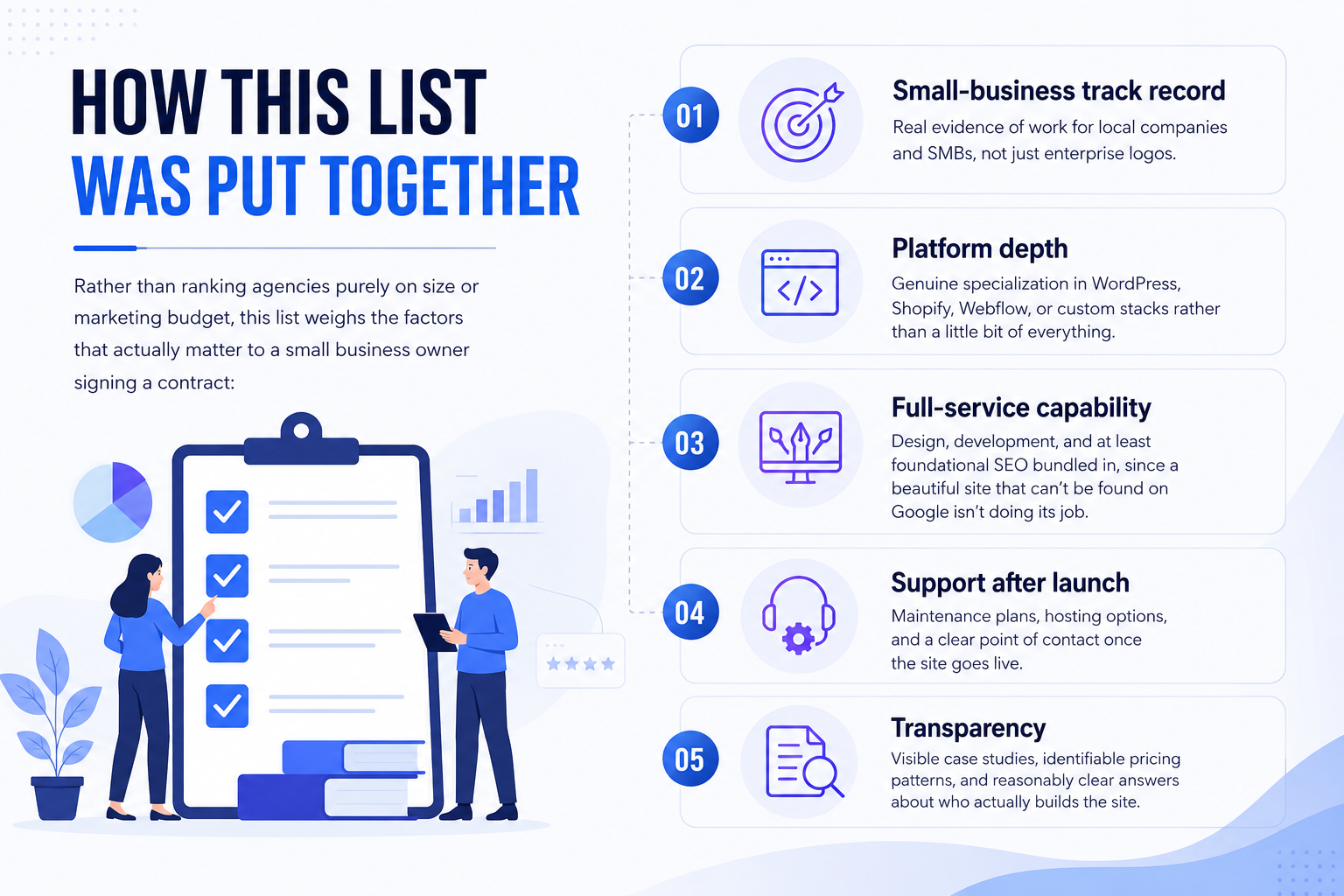
- Small-business track record — real evidence of work for local companies and SMBs, not just enterprise logos.
- Platform depth — genuine specialization in WordPress, Shopify, Webflow, or custom stacks rather than a little bit of everything.
- Full-service capability — design, development, and at least foundational SEO bundled in, since a beautiful site that can’t be found on Google isn’t doing its job.
- Support after launch — maintenance plans, hosting options, and a clear point of contact once the site goes live.
- Transparency — visible case studies, identifiable pricing patterns, and reasonably clear answers about who actually builds the site.
Rankings below reflect editorial assessment against those criteria, not a paid placement or sponsorship arrangement.
Quick Comparison Table
| Agency | Best For | Platform Focus | Team Size | Typical Project Range | Post-Launch Support |
|---|---|---|---|---|---|
| Agency Jet | Conversion-focused small business sites | Custom WordPress | 31–50 | $5,000–$18,000 | Yes |
| Mainstreethost | SEO-driven WordPress & eCommerce | WordPress, WooCommerce | 130+ | $4,000–$20,000 | Yes |
| Logical Position | Fast, budget-friendly launches | Custom CMS, eCommerce | 800+ | $3,000–$12,000 | Yes |
| WebDevStudios | Scalable, complex WordPress builds | WordPress (exclusive) | 35 | $10,000–$40,000+ | Yes |
| Ajroni | Affordable multi-platform builds | WordPress, Shopify, Webflow, custom | 10+ | $2,500–$15,000 | Yes |
| Buena Vista Creative | Brand-forward custom sites | WordPress, Shopify Plus | 10 | $5,000–$25,000 | Yes |
| DigitalSuits | eCommerce-first small businesses | Shopify, Shopify Plus, BigCommerce | 60 | $8,000–$30,000 | Yes |
| The Communications Group | Budget-conscious packages | WordPress, custom CMS | 20 | $2,000–$10,000 | Yes |
| The Whit Group | Local SEO-first sites | WordPress | 20 | $3,000–$12,000 | Yes |
| WebSpace Team | Startups and SaaS-style builds | React, Node.js, custom | 20–50 | $10,000–$50,000+ | Limited |
Figures reflect typical market ranges for projects of this type and scope rather than agency-quoted prices, since most agencies price by custom proposal.
The 10 Best Web Development Agencies for Small Businesses
1. Agency Jet — Best for Conversion-Focused Small Business Sites
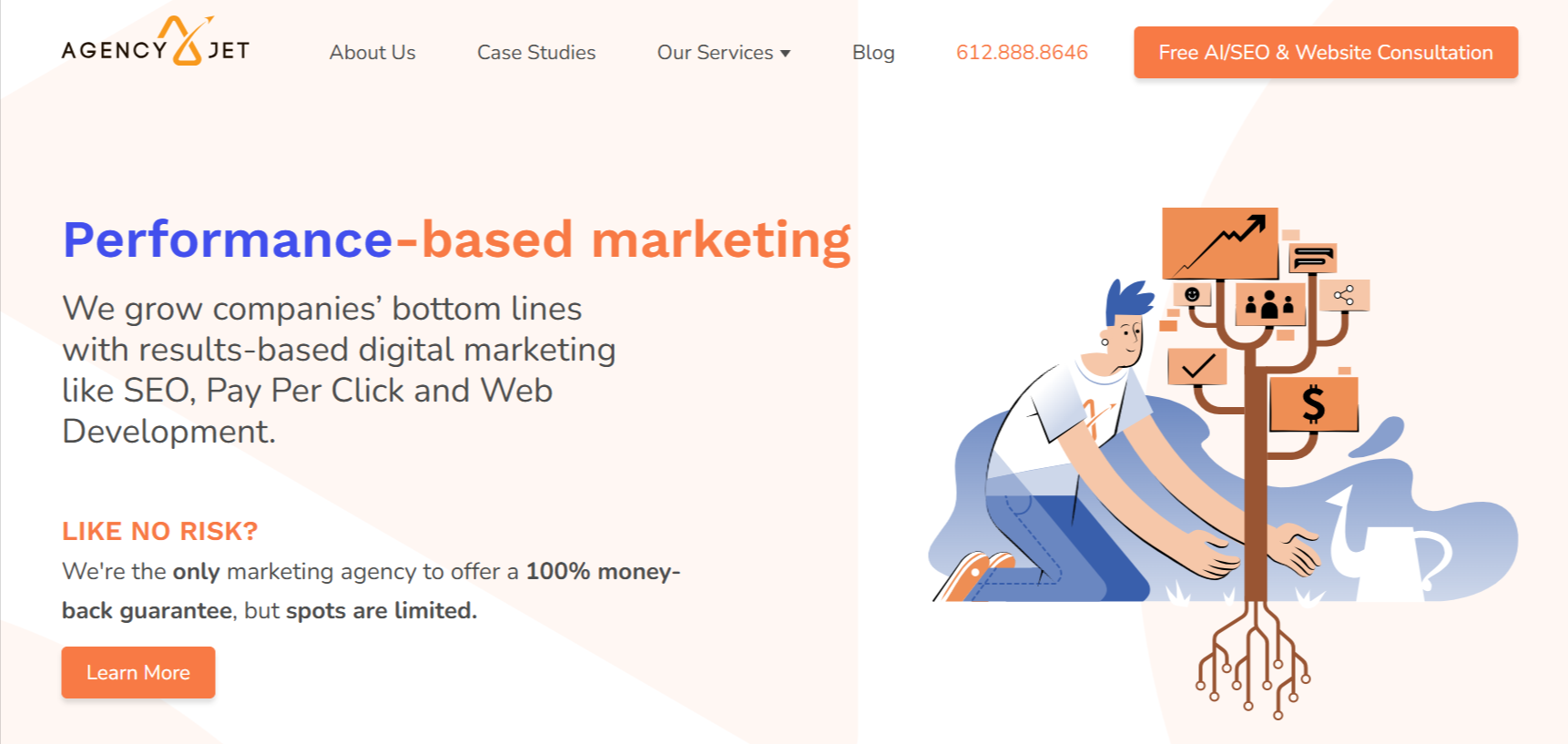
Agency Jet, based in Minneapolis, has built a reputation around sites that are judged less by how they look and more by what they get a visitor to do next. The team runs a mid-sized operation (roughly 30–50 people) and leans on custom WordPress builds rather than rigid templates.
Features: Custom WordPress development, conversion rate optimization built into the design process, SEO-ready site architecture, PPC and social media add-ons, brand identity work.
Pricing: Project-based quotes generally land between $5,000 and $18,000 depending on page count and whether eCommerce is involved. No published flat-rate packages.
Pros:
- Clear, structured project process that small business owners without technical backgrounds can follow
- Conversion thinking baked into design decisions rather than treated as an afterthought
- In-house team handles design, build, and marketing add-ons under one roof
Cons:
- Mid-size agency pricing sits above the cheapest DIY-adjacent competitors
- Less suited to businesses that need a pure eCommerce specialist
Performance: Sites are generally built with mobile responsiveness and clean code structure as a baseline, which supports both Core Web Vitals scores and basic technical SEO.
Best use case: A local service business (contractors, clinics, consultancies) that wants a lead-generation site, not just a digital brochure.
2. Mainstreethost — Best for SEO-Driven WordPress & eCommerce
Mainstreethost operates out of Erie County, NY, with a notably larger internal team (around 130 people) than most boutique competitors, which lets it bundle web development with an integrated SEO and content strategy rather than farming SEO out to a partner agency.
Features: WordPress and WooCommerce development, hosting, accessibility auditing, SEO and PPC, content marketing, responsive design.
Pricing: Entry-level WordPress builds start around $4,000; eCommerce stores with WooCommerce typically range from $8,000–$20,000 depending on catalog size and integrations.
Pros:
- SEO is genuinely integrated into the build, not a separate upsell
- Strong fit for businesses that want one vendor for both the website and ongoing search marketing
- Accessibility considerations are part of standard process, reducing legal/compliance risk
Cons:
- Larger team size can mean less direct face-time with senior staff compared to boutique shops
- WordPress-only focus means it’s not the right fit for headless or custom-stack projects
Performance: Sites are typically structured around keyword-targeted page architecture from day one, which tends to shorten the runway to organic ranking improvements.
Best use case: Local retailers or service businesses that want their website to double as a long-term SEO asset, not just a launch-and-forget project.
3. Logical Position — Best for Fast, Budget-Conscious Launches
Logical Position is one of the larger names on this list (800+ employees), originally built around paid search management and now offering web development as part of a broader digital marketing stack. Scale lets it move small business projects through production quickly.
Features: Responsive custom site builds, SEO fundamentals, PPC and paid social management, email marketing, analytics dashboards for non-technical owners.
Pricing: Generally the most budget-friendly tier on this list — straightforward sites often run $3,000–$8,000, with eCommerce and analytics add-ons pushing costs higher.
Pros:
- Fast turnaround thanks to large production capacity
- Built-in analytics dashboards make performance easy for owners to track without technical help
- One-stop option if you also want paid advertising managed alongside the build
Cons:
- Less emphasis on bespoke design compared to boutique studios
- At this scale, project managers (not always the same designer) may shift between phases
Performance: Adequate, standardized technical SEO baked into templated frameworks rather than fully custom architecture — fine for most SMBs, less ideal for highly specific functionality needs.
Best use case: A business that needs a professional site live fast and wants paid marketing running in parallel from day one.
4. WebDevStudios — Best for Scalable, Complex WordPress Builds
WebDevStudios is a 35-person team that works exclusively in WordPress, which sounds limiting until you see the depth: custom plugin development, BuddyPress community builds, API integrations, and enterprise-grade performance tuning, scaled down for businesses that have outgrown basic templates.
Features: WordPress strategy consulting, custom theme/plugin development, UX/UI design, API integrations, performance optimization, ongoing security and maintenance.
Pricing: This is the higher end of the small-business spectrum — typically $10,000 and up, with complex integration projects exceeding $40,000.
Pros:
- Deep WordPress specialization means fewer compromises on custom functionality
- Strong security and performance optimization practices
- Track record with recognizable brands lends credibility for businesses planning to scale
Cons:
- Pricing puts it out of reach for the smallest “just need a brochure site” businesses
- WordPress-exclusive focus rules it out for Shopify-first or headless projects
Performance: Strong technical foundation; custom-coded solutions tend to outperform plugin-stacked alternatives on page speed and stability over time.
Best use case: A growing small business that’s already outgrown a templated WordPress site and needs custom functionality (membership areas, complex integrations, multi-site management).
5. Ajroni — Best for Affordable Multi-Platform Builds
Ajroni, based in West Palm Beach, takes a platform-agnostic approach — WordPress, Shopify, Webflow, and custom stacks (Laravel, Vue.js, .NET) — plus mobile app development, which is unusual for an agency this size (roughly 10+ employees).
Features: Web design and development across multiple platforms, eCommerce builds, SEO and digital marketing, mobile app development (React Native/Flutter), maintenance plans.
Pricing: Among the more accessible options here, generally $2,500–$15,000 depending on platform and complexity.
Pros:
- Platform flexibility means the agency adapts to your business rather than the reverse
- Lower entry price point than several competitors on this list
- Mobile app capability is a meaningful bonus for businesses planning to expand beyond the web
Cons:
- Smaller team size may mean longer queues during busy periods
- Breadth across platforms can come at the cost of the depth a single-platform specialist offers
Performance: Generally solid, standard-practice responsive and SEO-friendly builds; performance depends heavily on which platform is chosen for the project.
Best use case: A small business unsure whether it needs WordPress, Shopify, or something custom, and that wants one team capable of advising and building across all three.
6. Buena Vista Creative — Best for Brand-Forward Custom Sites
Buena Vista Creative, a 10-person Miami studio, leans hard into the idea that a small business website should look and feel like a real brand, not a template. The agency pairs web development with brand identity, video, and photography services.
Features: Custom WordPress and Shopify Plus development, brand identity, SEO and PPC, social and email/SMS marketing, photography and video production.
Pricing: Typically $5,000–$25,000, scaling with how much branding and content production is bundled into the project.
Pros:
- Strong visual and brand sensibility — useful for businesses rebranding alongside a new site
- In-house photo/video capability removes the need for a separate content vendor
- Boutique size generally means closer collaboration with senior staff
Cons:
- Premium creative positioning means higher cost than purely functional competitors
- Not the first choice for businesses that need fast, no-frills execution
Performance: Custom builds tend to perform well, though heavy visual/video content requires careful optimization to protect page speed — worth confirming directly in scoping calls.
Best use case: A small business relaunching its brand identity at the same time as its website — think boutique retailers, hospitality, or consumer-facing service brands.
7. DigitalSuits — Best for eCommerce-First Small Businesses
DigitalSuits, a 60-person Miami-based shop, is built almost entirely around Shopify and Shopify Plus, with BigCommerce and headless commerce as secondary specialties. If your business is fundamentally an online store, this is one of the more focused options on the list.
Features: Shopify/Shopify Plus development, custom theme builds, platform migrations, headless commerce, AI feature integration, UX/UI design, QA testing, ongoing support.
Pricing: Generally $8,000–$30,000, with simpler Shopify stores at the lower end and complex Plus migrations toward the top.
Pros:
- Deep, focused Shopify expertise rather than commerce as a side service
- Migration experience reduces risk for businesses moving off other platforms
- QA testing as a standard step helps catch checkout and payment issues before launch
Cons:
- Single-platform focus isn’t useful if your business needs a content-heavy WordPress site
- Pricing reflects specialist positioning — not the cheapest option for a simple store
Performance: Shopify’s hosted infrastructure already handles much of the heavy lifting on uptime and security; DigitalSuits’ value-add shows up in theme customization and checkout conversion tuning.
Best use case: A product-based small business that needs a real eCommerce specialist rather than a generalist agency bolting Shopify onto its service list.
8. The Communications Group — Best for Budget-Friendly Packages
Based in Little Rock, this 20-person agency has built its small-business offering around templated and semi-custom website packages that keep costs predictable, paired with a broader marketing and PR practice.
Features: Web design and development, SEO audits, customizable templates and drag-and-drop tools, brand strategy, advertising, content marketing, public relations.
Pricing: Among the most affordable on this list, roughly $2,000–$10,000 for most small business projects.
Pros:
- Predictable, package-based pricing makes budgeting easier for first-time website buyers
- Broader marketing/PR bench available if the business wants more than just a website later
- SEO audit included as a standard step rather than an extra line item
Cons:
- Template-based options trade some customization for cost savings
- Less suited to businesses needing heavy custom functionality
Performance: Reasonable baseline performance for templated builds; fully custom projects will need a larger budget to unlock the agency’s higher-end capabilities.
Best use case: A small business on a tighter budget that still wants professional design and a basic SEO foundation rather than a pure DIY build.
9. The Whit Group, LLC — Best for Local SEO-First Websites
The Whit Group, a 20-person team in Ridgeland, MS, focuses heavily on local visibility — the kind of site built specifically to show up when someone nearby searches for the service a small business offers.
Features: WordPress development, local SEO, social media management, hosting, mobile app development for businesses that need it.
Pricing: Generally $3,000–$12,000, scaling with the number of service/location pages required.
Pros:
- Local SEO structure (location pages, schema, Google Business Profile alignment) is a core competency, not an afterthought
- WordPress focus keeps long-term editing simple for non-technical owners
- Mobile app option available for businesses that eventually want one
Cons:
- Smaller agency means less bandwidth for very large, multi-region projects
- Less relevant for purely eCommerce-driven businesses
Performance: Strong local search foundations tend to produce faster visibility gains for “near me” style search intent compared to generic, non-localized site structures.
Best use case: A single-location or multi-location local business (home services, healthcare, legal, retail) competing primarily on local search visibility.
10. WebSpace Team — Best for Startups and SaaS-Style Builds
WebSpace Team, a San Francisco-based team of 20–50, is the outlier on this list — it’s less a “build me a brochure site” agency and more a custom software shop that happens to build small business websites along the way, using React, Node.js, and mobile frameworks.
Features: Custom web and mobile app development, UX/UI design, SaaS and MVP development, QA testing, app modernization.
Pricing: The highest range on this list — typically $10,000 to $50,000+, reflecting custom software development rather than templated website work.
Pros:
- Genuine software engineering depth, useful if “website” is really shorthand for “web application”
- Strong fit for founders building a product, not just a marketing site
- Modern tech stack (React/Node.js) supports fast, scalable interfaces
Cons:
- Significant overkill — and overspend — for a business that just needs a standard marketing website
- Support after launch is more limited than agencies built specifically around small business maintenance needs
Performance: Custom-coded React/Node applications can outperform CMS-based sites on speed and interactivity, but require more technical oversight to maintain long-term.
Best use case: An early-stage startup or small business with a software product (booking platform, marketplace, internal tool) that needs more than a content management system can offer.
Performance: How These Agencies Actually Stack Up
Performance in web development isn’t just “does the site look nice” — it’s page speed, Core Web Vitals scores, mobile responsiveness, and how cleanly the site is structured for both Google and, increasingly, AI-driven answer engines.
Generally speaking, single-platform specialists (DigitalSuits on Shopify, WebDevStudios on WordPress) tend to produce more consistent technical performance because they aren’t splitting attention across multiple tech stacks. Multi-platform generalists (Ajroni, Buena Vista Creative) trade a small amount of consistency for flexibility — useful if you’re not sure which platform fits your business yet. Scale players (Logical Position, Mainstreethost) lean on standardized, repeatable build processes, which keeps quality predictable but can mean less bespoke performance tuning unless you specifically ask for it.
If page speed and search visibility are priorities — and for most small businesses, they should be — ask any agency directly what their Core Web Vitals targets are and what tools they use to test before launch (PageSpeed Insights and Lighthouse are the industry standard).
Web Development Agencies by Audience: Who Should Choose What
For eCommerce Sellers
If your business sells physical or digital products online, prioritize agencies with genuine commerce-platform depth rather than generalists. DigitalSuits is the strongest pure-play option here, with Shopify/Shopify Plus specialization, migration experience, and QA processes built around checkout reliability. Mainstreethost is a solid alternative for sellers who want WooCommerce on WordPress paired with SEO. Look specifically for experience with payment gateway integration, inventory syncing, and abandoned-cart recovery — these are the features that affect revenue, not just appearance.
For Content Creators
Creators, coaches, and personal-brand businesses usually need a site that’s easy to update constantly — new posts, offers, or media — without calling a developer every time. WebDevStudios and The Whit Group both lean on WordPress, the most editor-friendly CMS for non-technical creators, with plugin ecosystems that support memberships, courses, and email capture out of the box.
For Marketers and Agencies Themselves
If you’re a marketer building (or rebuilding) a client-facing or personal portfolio site, speed-to-launch and SEO structure matter more than deep custom functionality. Logical Position and The Communications Group both offer faster, more standardized builds with SEO basics included, which suits marketers who want a credible site live quickly rather than a multi-month custom build.
For General Small Businesses (Service & Local)
Most local service businesses — contractors, clinics, salons, consultancies — benefit most from agencies that combine clean design with local SEO structure. Agency Jet and The Whit Group both build conversion- and local-search-oriented sites specifically suited to businesses competing for nearby customers rather than national search volume.
How to Choose a Web Development Agency: A Practical Framework
Start with the platform question. A content-heavy business with a blog or resource library is usually best served by WordPress. A product-based business should default to Shopify unless there’s a strong reason not to. A business with unusual functionality needs (booking systems, custom dashboards, marketplace features) may need a custom build — which costs more but avoids forcing a square peg into a round CMS.
Clarify what “done” actually includes. Ask whether the price covers copywriting, photography, stock images, basic SEO setup, analytics installation, and a training session on how to update the site yourself. Scope creep usually happens because these were assumed, not confirmed.
Confirm who you’ll actually be working with. Some agencies pitch senior talent during sales calls and then hand the build to junior staff or offshore contractors. There’s nothing wrong with offshore development if it’s disclosed and the quality holds up — the problem is when it’s hidden.
Ask about post-launch reality, not just the launch date. A website is a living asset. Plugin updates, security patches, broken forms, and content refreshes are ongoing. Agencies that get vague when asked “what happens after launch?” are telling you something important.
Get a real handle on budget before requesting quotes. Have a rough page count, a yes/no on eCommerce, a CMS preference (or no preference), and clarity on whether you need the agency to write copy or take photos. A vague brief produces incomparable quotes.
Questions Worth Asking on a Discovery Call
- Which platform do you recommend for a business like mine, and why that one specifically?
- Can I see two or three live sites you’ve built for businesses of similar size?
- Who designs and codes the site — in-house staff, or subcontractors?
- What’s included in the quoted price, and what typically becomes an add-on?
- Who hosts the site after launch, and what does that cost ongoing?
- What’s a realistic timeline from signed contract to live site?
- Is SEO part of the build process, or a separate service I’d need to add?
- What does your maintenance plan include, and what’s the monthly cost?
Red Flags That Should Make You Pause
- No visitable portfolio. Mockups and screenshots aren’t proof. Ask for live URLs.
- Evasive answers about who builds the site. If they won’t say clearly, assume it’s outsourced — and ask what that means for quality control and communication.
- Silence on post-launch support. An agency focused entirely on the build, with no answer for “then what,” tends to disappear after the invoice clears.
- Guaranteed #1 Google rankings. No legitimate agency can guarantee a specific ranking position — search algorithms are outside anyone’s full control.
- Prices that seem too good for the scope. A few hundred dollars for a multi-page site with booking, payments, and custom design usually means a heavily templated build or inexperienced execution.
- They register the domain or hosting in their own name. This should always be in your name. Holding your domain hostage is a classic lock-in tactic.
Pricing Models in 2026: Project, Retainer, or Credit-Based
Most agencies on this list still price by custom project quote — you describe scope, they price the build. But two other models have grown more common heading into 2026:
- Retainer/subscription pricing, where a flat monthly fee (often $300–$2,000) covers ongoing design and development hours, useful for businesses that expect frequent changes rather than a one-time build.
- Credit or matching-platform models, increasingly used by marketplaces that connect businesses with vetted freelancers or agencies — you purchase a project credit or use a promotional discount code toward your first engagement, then negotiate scope directly with the matched provider.
Whichever model an agency offers, ask explicitly what happens to unused hours or credits, whether they roll over, and what the cancellation terms look like before signing anything.
Alternatives to Hiring a Web Development Agency
An agency isn’t the only path to a working website, and for some businesses it isn’t even the right one yet.
- DIY builders (Wix, Squarespace, Shopify’s own builder): Reasonable for a single-location service provider, a personal portfolio, or a business testing an idea before investing in a custom build. Costs typically run $0–$50/month.
- Freelancers: A middle ground — generally $1,500–$8,000 for a custom site, often faster and cheaper than an agency, though with more variability in reliability and post-launch support.
- Webflow specialists: Worth considering if you want strong design control and a clean visual CMS without deep custom coding — a popular middle path between WordPress flexibility and DIY simplicity.
- In-house hire: Rarely cost-effective for a single website, but can make sense once a business has ongoing, continuous web and content needs beyond a single build.
None of these replace a full-service agency’s combination of strategy, design, development, and support — but they’re legitimate options depending on budget and complexity.
Also Read : How Rapid Web App Development Works: Top Tools, Steps, and Best Practices
Frequently Asked Questions
How much should a small business budget for a website in 2026? Most professionally built small business sites fall between $2,500 and $15,000, with basic brochure sites at the lower end and eCommerce or custom-feature builds pushing toward the top. Highly templated DIY builds can cost under $500/year, while complex custom platforms can exceed $30,000.
How long does a typical project take? A standard 5–10 page site usually takes 4–8 weeks from kickoff to launch. eCommerce builds with product setup and payment integration generally take 8–16 weeks. The biggest cause of delay is almost always the client side — late content, photos, or feedback.
Should I choose WordPress, Shopify, Webflow, or a custom build? WordPress fits content-heavy, blog-driven, or highly flexible projects. Shopify is purpose-built for online stores and remains easier to manage for eCommerce. Webflow suits marketing-focused sites where design control matters but heavy coding doesn’t. Custom builds make sense only when your functionality needs genuinely exceed what any off-the-shelf platform offers.
Is SEO included, or should I budget for it separately? It depends entirely on the agency. The strongest agencies on this list build basic SEO — clean URLs, metadata, mobile responsiveness, schema markup — directly into the development process. Ongoing SEO (content, link building, continued optimization) is almost always a separate, ongoing service regardless of who builds the site.
Do I need a maintenance plan after launch? Yes, for any CMS-based site (WordPress especially). Plugins and core software need regular updates to stay secure. Typical maintenance plans run $50–$500/month depending on how hands-on the support is. Shopify and similar hosted platforms handle more infrastructure automatically, but periodic reviews are still worthwhile.
What happens to my site if I leave the agency? If your domain, hosting, and CMS are registered in your own name — which they always should be — you keep full control and can move freely. If the agency holds any of these under its own account, get a written handoff clause before signing anything.
Does AI search change how I should think about website SEO in 2026? Yes, to a degree. AI answer engines (ChatGPT, Gemini, Google’s AI Overviews) increasingly pull from structured, clearly written, well-organized web content. Clean technical SEO, clear headings, and factual, well-organized page content help both traditional search rankings and visibility inside AI-generated answers.
Final Verdict
There’s no single “best” web development agency for every small business — the right pick depends on platform, budget, and how much ongoing support you actually need. For most general small businesses wanting a conversion-focused, professionally supported site, Agency Jet and Mainstreethost are strong, well-rounded starting points. eCommerce-first sellers should look hardest at DigitalSuits, while businesses with complex, software-like needs are better served by WebSpace Team or WebDevStudios.
Whichever agency you shortlist, the fundamentals from this guide hold regardless of size or specialty: confirm who actually builds the site, get clarity on post-launch support before you sign, keep your domain and hosting in your own name, and make sure SEO is part of the build — not an upsell waiting for you after launch.