
New Product Development: Key Risks and Challenges in Project Management

Bringing a new product to market is one of the most exciting yet perilous journeys a business can undertake. While the potential rewards are substantial—increased revenue, competitive advantage, and market leadership—the path is fraught with obstacles that can derail even the most promising initiatives.
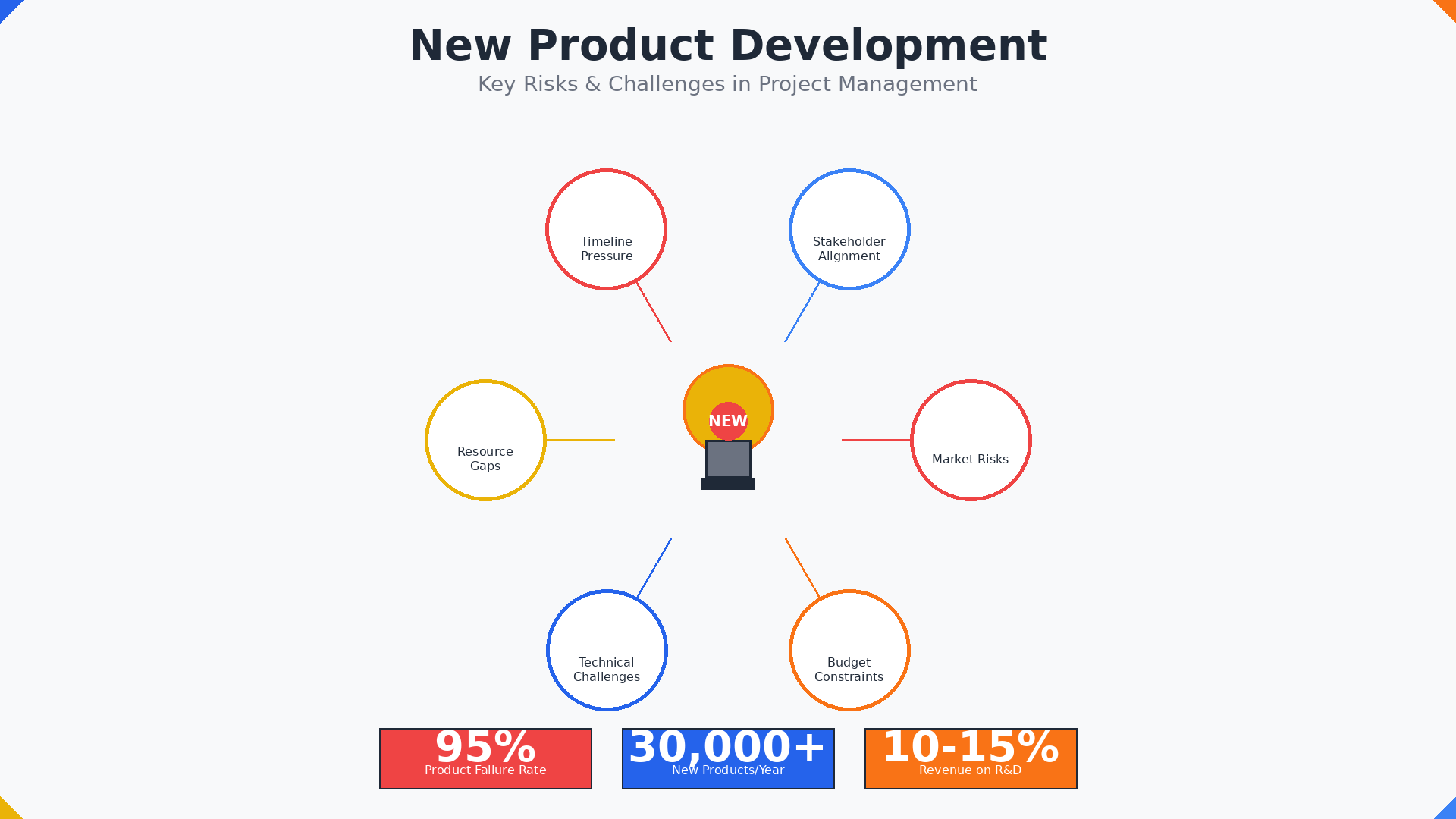
According to research from Harvard Business School, approximately 30,000 new products are introduced each year, yet 95% of them fail to meet their objectives. This staggering statistic underscores a critical reality: successful product development requires more than just a great idea. It demands rigorous project management, strategic foresight, and the ability to navigate a complex landscape of interconnected challenges.
The stakes have never been higher. In today’s fast-paced business environment, companies face compressed development timelines, evolving customer expectations, and intensifying competition. A single misstep—whether in market research, resource allocation, or execution—can result in millions of dollars in losses and significant damage to brand reputation.
Understanding the new product development risks and challenges in project management is essential for organizations seeking to improve their success rates and maximize return on innovation investments. This comprehensive guide explores the most critical obstacles product teams face and provides actionable strategies to overcome them.
The High-Stakes Landscape of New Product Development
The new product development (NPD) process represents a significant investment of time, capital, and human resources. McKinsey research indicates that companies typically allocate 10-15% of their annual revenue to innovation and product development activities.
However, this substantial investment comes with considerable uncertainty. Market dynamics shift rapidly, technology evolves continuously, and consumer preferences remain notoriously difficult to predict. These factors create a volatile environment where even well-resourced projects can struggle to achieve their intended outcomes.
The complexity intensifies when you consider that successful NPD requires coordination across multiple departments—R&D, marketing, sales, finance, operations, and supply chain. Each function brings its own priorities, timelines, and constraints, making alignment and collaboration essential yet challenging.
Critical Risks in New Product Development Project Management
Market-Related Challenges
Insufficient Market Research and Validation
One of the most fundamental risks in NPD is launching a product that doesn’t address a genuine market need. Many organizations fall into the trap of building solutions in search of problems, driven by technological capabilities rather than customer pain points.

Companies often fail to conduct adequate market research or misinterpret the data they collect. This can manifest in several ways:
- Overestimating market size or willingness to pay
- Misjudging the competitive landscape
- Failing to identify emerging substitutes or alternatives
- Ignoring critical customer segments or use cases
The consequences are severe. Products that miss the market mark require costly pivots, extended development cycles, or complete abandonment—all of which drain resources and erode stakeholder confidence.
Changing Customer Expectations
Consumer preferences evolve rapidly, particularly in technology-driven sectors. What resonates with customers today may become obsolete within months. This creates a moving target for product teams working on development cycles that often span 12-24 months or longer.
The challenge intensifies in B2B contexts, where purchasing decisions involve multiple stakeholders, each with distinct requirements and evaluation criteria. Balancing these competing demands while maintaining a coherent product vision tests even the most experienced project managers.
Resource and Budget Constraints
Scope Creep and Feature Bloat
Scope creep remains one of the most persistent new product development risks and challenges in project management. As projects progress, stakeholders frequently request additional features, modifications, or enhancements that seem minor individually but collectively expand the project scope beyond original parameters.
This phenomenon occurs for several reasons:
- Competitive pressure to match rival offerings
- Internal stakeholder influence and politics
- Evolving understanding of customer needs
- Technical team enthusiasm for innovative capabilities
Without disciplined governance, scope creep leads to budget overruns, delayed launches, and diluted value propositions. Products become overcomplicated, confusing to users, and difficult to market effectively.
Resource Allocation and Talent Gaps
Developing new products requires specialized skills across multiple disciplines—engineering, design, marketing, and data analysis. However, organizations frequently underestimate the talent required or struggle to secure the right expertise at the right time.
Key resource challenges include:
- Competition for limited internal talent across concurrent projects
- Difficulty hiring or retaining specialized skills in tight labor markets
- Knowledge silos that impede cross-functional collaboration
- Inadequate training or onboarding for team members
These gaps can significantly impact development velocity, product quality, and time-to-market—three factors that directly influence commercial success.
Technical and Execution Risks
Technology Integration Challenges
Modern products rarely exist in isolation. They must integrate with existing systems, third-party platforms, and evolving technology ecosystems. These integration requirements introduce significant complexity and risk.
Technical challenges include:
- Compatibility issues across platforms and devices
- Security vulnerabilities and data privacy concerns
- Scalability limitations that emerge only under real-world conditions
- Dependencies on third-party APIs or services beyond your control
Each integration point represents a potential failure mode that requires careful planning, testing, and contingency preparation.
Quality Assurance and Testing Gaps
Pressure to accelerate time-to-market often leads teams to compress or skip critical testing phases. This creates substantial risk, as quality issues discovered post-launch are exponentially more expensive to address than problems identified during development.
Inadequate testing can result in:
- Product recalls and costly remediation efforts
- Negative reviews and damaged brand reputation
- Customer churn and reduced lifetime value
- Regulatory compliance failures and associated penalties
Organizational and Communication Barriers
Cross-Functional Alignment Issues
NPD success depends on seamless collaboration between departments with fundamentally different perspectives and priorities. Engineering teams prioritize technical excellence, marketing focuses on positioning and messaging, sales emphasizes revenue generation, and finance monitors cost control.
These divergent objectives create natural tension that, if poorly managed, can derail projects through:
- Conflicting decisions and duplicated efforts
- Information silos and communication breakdowns
- Delayed decision-making due to unclear authority
- Misaligned incentives that undermine collective goals
Stakeholder Management Complexity
Product development involves numerous stakeholders—executives, investors, customers, partners, and internal teams. Each group has distinct interests, expectations, and influence levels that must be carefully managed.
Challenges include:
- Balancing short-term financial pressures with long-term strategic vision
- Managing executive expectations regarding timelines and outcomes
- Incorporating customer feedback without losing strategic focus
- Navigating political dynamics and power structures
Strategic Approaches to Mitigating NPD Risks
Implement Stage-Gate Processes
Adopting a structured stage-gate methodology provides critical checkpoints throughout the development lifecycle. This approach divides the NPD process into distinct stages—ideation, scoping, business case, development, testing, and launch—each separated by gates where projects must meet specific criteria to advance.
Benefits include:
- Early identification and termination of weak concepts
- Controlled resource allocation based on project maturity
- Reduced risk through incremental validation
- Improved decision-making with standardized evaluation criteria
Embrace Agile and Iterative Development
Traditional waterfall approaches struggle to accommodate the uncertainty inherent in new product development risks and challenges in project management. Agile methodologies offer greater flexibility through iterative cycles, continuous feedback, and adaptive planning.
Key practices include:
- Regular sprint cycles with defined deliverables
- Continuous customer engagement and testing
- Cross-functional teams with end-to-end ownership
- Rapid prototyping and minimum viable product (MVP) approaches
This iterative approach enables teams to validate assumptions early, pivot when necessary, and deliver value incrementally rather than waiting for a big-bang launch.
Strengthen Market Intelligence Capabilities
Reducing market-related risks requires robust research capabilities and customer insights. Leading organizations invest in:
- Ongoing customer discovery and ethnographic research
- Competitive intelligence and market monitoring
- Data analytics to identify trends and patterns
- Beta programs and pilot initiatives with target customers
This continuous learning approach helps teams stay connected to market realities and make informed decisions throughout the development process.
Build Multidisciplinary Teams with Clear Governance
Effective NPD requires dedicated, cross-functional teams with clear roles, responsibilities, and decision-making authority. Best practices include:
- Appointing empowered product owners with P&L accountability
- Establishing steering committees for strategic oversight
- Creating RACI matrices to clarify accountabilities
- Implementing communication protocols and collaboration tools
Clear governance structures reduce confusion, accelerate decisions, and ensure alignment across the organization.
Market Trends Shaping Product Development
Several macro trends are transforming how organizations approach new product development:
Digital-First Innovation
The shift to digital-first strategies has accelerated dramatically. Companies now prioritize digital products and services, requiring new capabilities in software development, data analytics, and user experience design.
Sustainability and ESG Considerations
Environmental, social, and governance factors increasingly influence product development decisions. Consumers and investors demand sustainable products, circular economy principles, and transparent supply chains—adding new dimensions to the development process.
AI and Automation Integration
Artificial intelligence is revolutionizing NPD through predictive analytics for market forecasting, generative design for rapid prototyping, and automation for testing and quality assurance. Organizations that harness these capabilities gain significant competitive advantages.
Speed to Market Imperative
Competitive pressure continues to compress development timelines. The average time-to-market has decreased by 30% over the past decade, forcing teams to balance speed with quality and strategic thoughtfulness.
Frequently Asked Questions
What is the most common reason new products fail in project management?
The most prevalent cause of new product failure is insufficient market validation. Many products fail not because of poor execution but because they solve problems customers don’t actually have or aren’t willing to pay to solve. This typically results from inadequate market research, confirmation bias in interpreting customer feedback, or launching without proper testing with target users. Successful teams invest heavily in customer discovery, validate assumptions through MVP testing, and remain willing to pivot or terminate projects when market evidence doesn’t support continued investment.
How can project managers effectively control scope creep in NPD initiatives?
Controlling scope creep requires disciplined governance and clear prioritization frameworks. Effective approaches include establishing a formal change control process where all scope modifications must be evaluated against impact on timeline, budget, and strategic objectives. Product teams should maintain a ruthlessly prioritized backlog, use techniques like MoSCoW prioritization (Must have, Should have, Could have, Won’t have) to make trade-off decisions transparent, and empower product owners to say “no” to requests that don’t align with core value propositions. Regular stakeholder communication about trade-offs between features, quality, and delivery timelines also helps manage expectations and prevent unauthorized scope expansion.
What role does cross-functional collaboration play in mitigating NPD risks?
Cross-functional collaboration is essential for identifying and mitigating risks that individual departments might not recognize. Engineering teams may spot technical constraints early, marketing can identify positioning challenges, operations can flag supply chain issues, and finance can surface budget concerns—all before they become critical problems. Effective collaboration requires co-located or tightly integrated teams, regular synchronization meetings, shared objectives and metrics, and tools that facilitate transparency and information sharing. Organizations that excel at cross-functional collaboration typically experience 40-50% fewer post-launch issues and significantly faster time-to-market compared to siloed approaches.
How should organizations balance innovation with risk management in product development?
Balancing innovation and risk requires a portfolio approach to product development. Leading organizations maintain a mix of incremental improvements to existing products (lower risk, predictable returns), adjacent innovations that leverage current capabilities in new ways (moderate risk and reward), and transformational innovations that explore entirely new markets or technologies (higher risk, potentially transformative returns). This portfolio approach allows companies to pursue ambitious innovation while managing overall risk exposure. Additionally, using stage-gate processes, MVP approaches, and kill criteria helps organizations make disciplined go/no-go decisions based on evidence rather than emotional attachment to ideas.
What metrics should project managers track to identify NPD risks early?
Critical early warning metrics include burn rate versus planned budget, velocity of feature completion compared to baseline, stakeholder satisfaction scores from regular surveys, technical debt accumulation, and market validation metrics like customer interview completion rates and prototype testing results. Leading indicators like decision-making velocity, unresolved dependencies, and team morale can also signal emerging problems. The most sophisticated organizations create risk dashboards that consolidate these metrics, apply weighted scoring to assess overall project health, and trigger escalation protocols when thresholds are breached. Regular risk reviews—weekly for critical projects, bi-weekly for others—ensure issues surface quickly while mitigation options remain viable.
Conclusion: Navigating Complexity for NPD Success
Successfully managing new product development requires acknowledging and actively addressing the multifaceted risks inherent in bringing innovation to market. The new product development risks and challenges in project management are substantial, but they are not insurmountable.
Organizations that implement structured processes, embrace iterative methodologies, invest in market intelligence, and foster cross-functional collaboration significantly improve their odds of success. The key is recognizing that NPD is inherently uncertain and building capabilities to navigate that uncertainty effectively.
The companies that thrive in today’s competitive landscape are those that view product development not as a linear, predictable process but as a dynamic capability requiring continuous learning, adaptation, and disciplined execution. By understanding the risks, implementing proven mitigation strategies, and maintaining unwavering focus on customer value, organizations can transform product development from a gamble into a strategic competitive advantage.
The question is not whether your next product development initiative will face challenges—it certainly will. The question is whether your organization has the capabilities, processes, and culture to overcome them.
