
What Is Adaptive Software Development and Why It Matters Today

In today’s fast-paced digital landscape, businesses can’t afford to spend years building software that’s outdated before it even launches. Market conditions shift, customer preferences evolve, and technology advances at breakneck speed.
Traditional software development methodologies, with their rigid planning and linear execution, often struggle to keep pace. That’s where adaptive software development comes in—a methodology designed specifically for the unpredictable nature of modern software projects.
Understanding what adaptive software development is has become essential for any organization looking to remain competitive. This approach prioritizes flexibility, collaboration, and continuous learning over strict adherence to predetermined plans.
According to recent industry data, companies using adaptive methodologies report 28% faster time-to-market and 37% higher customer satisfaction rates compared to those using traditional approaches. These aren’t just numbers—they represent real competitive advantages in markets where being first often means being best.
What Is Adaptive Software Development?
Adaptive Software Development (ASD) is an agile methodology that embraces change as a natural and beneficial part of the software creation process. Unlike traditional waterfall approaches that view changes as disruptions, ASD treats uncertainty as an opportunity for innovation and improvement.
Created by Jim Highsmith and Sam Bayer in the early 1990s, this methodology emerged from their work on rapid application development projects. They recognized that complex software systems couldn’t be fully understood or planned upfront—instead, understanding emerges through iteration and collaboration.
Core Philosophy
At its heart, adaptive software development acknowledges three fundamental truths:
- Change is inevitable – Requirements evolve as stakeholders learn more about what they actually need
- Collaboration beats prediction – Working together produces better results than trying to plan everything in advance
- Learning drives progress – Each iteration provides valuable insights that inform future decisions
This philosophy represents a fundamental shift from “plan the work, work the plan” to “learn, adapt, and evolve.”
The Three-Phase Adaptive Software Development Lifecycle
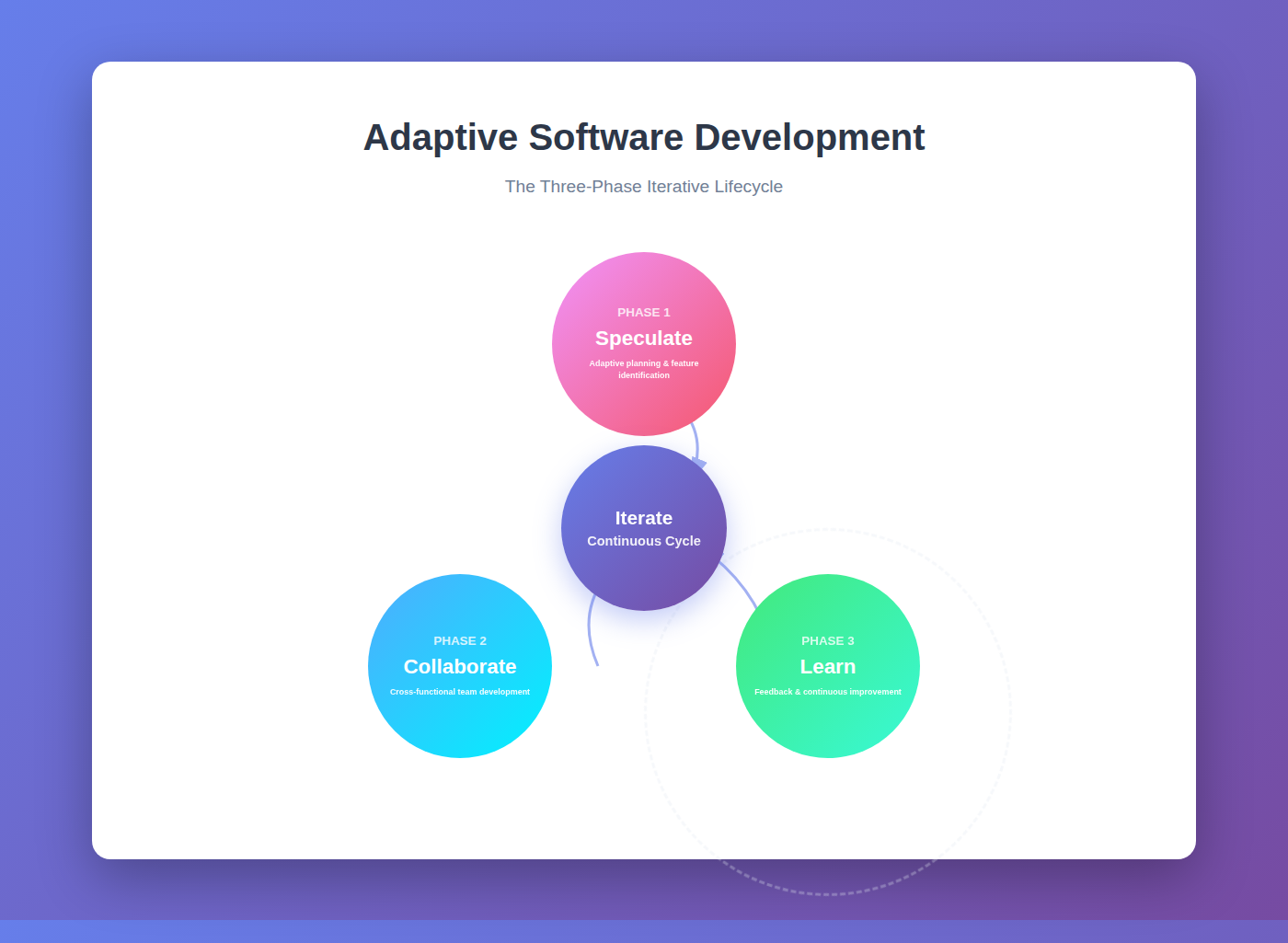
Unlike traditional methodologies with numerous sequential phases, ASD simplifies the process into three iterative cycles that repeat throughout the project.
1. Speculate
The Speculate phase replaces traditional planning with adaptive planning. Instead of creating comprehensive documentation that attempts to predict every detail, teams:
- Define the project mission and objectives
- Identify feature sets that deliver value
- Create time-boxed iterations (typically 4-8 weeks)
- Establish success criteria without over-constraining the solution
This phase acknowledges that we can’t know everything upfront. The term “speculate” is intentional—it recognizes that initial plans are educated guesses that will evolve.
2. Collaborate
Collaboration forms the engine of adaptive software development. During this phase, cross-functional teams work together intensively to build the software. Key characteristics include:
- Daily communication between developers, stakeholders, and users
- Parallel development of different components
- Continuous integration of work products
- Real-time problem-solving and decision-making
This collaborative approach breaks down silos and ensures everyone remains aligned despite changing circumstances. When you hire developers for adaptive projects, look for strong communication skills alongside technical expertise.
3. Learn
The Learn phase distinguishes ASD from other methodologies. Rather than simply reviewing deliverables, teams conduct focused learning sessions to:
- Assess what worked and what didn’t
- Gather feedback from stakeholders and users
- Identify improvements for the next iteration
- Adjust the project direction based on insights gained
This continuous learning loop ensures that each iteration builds on accumulated knowledge, making the product progressively better aligned with actual needs.
Why Adaptive Software Development Matters in 2024
The business environment has changed dramatically over the past decade. Several trends have made adaptive approaches not just beneficial but essential:
Accelerating Market Changes
Industries transform faster than ever. A product specification created six months ago may address problems customers no longer care about. Adaptive software development allows teams to pivot quickly as market conditions shift.
Increased Complexity
Modern software rarely exists in isolation. Today’s applications integrate with numerous third-party services, operate across multiple platforms, and must satisfy diverse user expectations. This complexity makes comprehensive upfront planning nearly impossible.
Competitive Pressure
Companies that can release functional products quickly gain significant advantages. Adaptive methodologies support rapid releases and continuous improvements, helping businesses stay ahead of competitors still locked in lengthy development cycles.
Customer Expectations
Users expect regular updates and improvements. The adaptive approach naturally supports continuous delivery, meeting modern expectations for constantly evolving software experiences.
Key Benefits of Adaptive Software Development
Organizations implementing ASD typically experience several significant advantages:
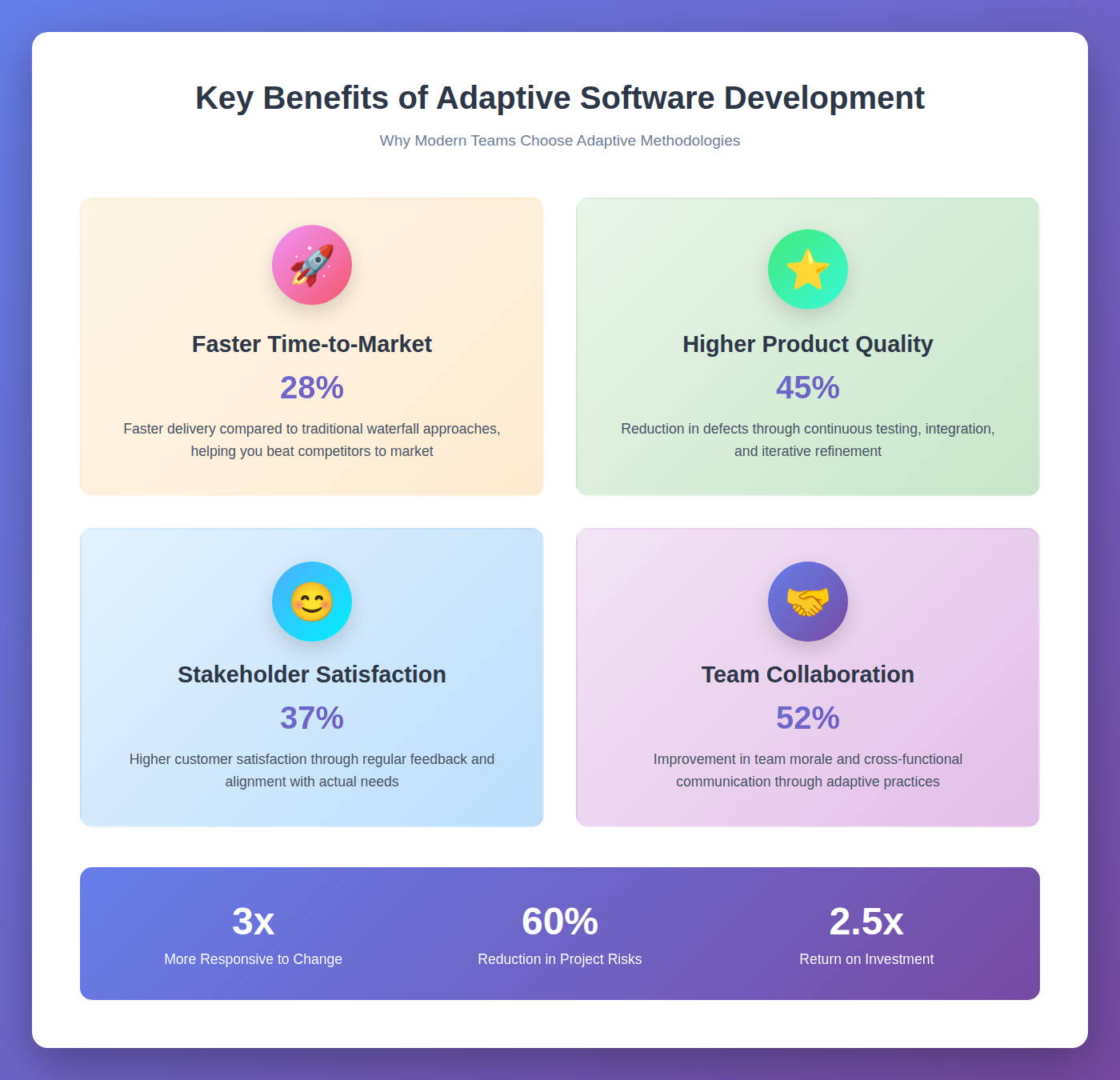
Faster Time-to-Market
By working in short iterations and prioritizing essential features, teams can release valuable functionality quickly. Early releases generate revenue sooner and provide competitive advantages.
Higher Product Quality
Continuous testing, integration, and feedback throughout the development process catch issues early. This iterative refinement produces more robust, user-friendly applications than traditional approaches.
Better Stakeholder Satisfaction
Regular demonstrations and opportunities for input ensure stakeholders get products that truly meet their needs. They’re not stuck waiting months to discover the final product doesn’t match their expectations.
Improved Team Morale
Developers appreciate the autonomy and collaboration inherent in adaptive approaches. Teams report higher job satisfaction when they can make decisions, solve problems creatively, and see the immediate impact of their work.
Risk Reduction
Breaking projects into short iterations limits exposure. If an approach isn’t working, teams discover this quickly and can adjust before investing significant resources in the wrong direction.
Adaptive Software Development vs. Traditional Methodologies
Understanding the differences helps organizations choose the right approach:
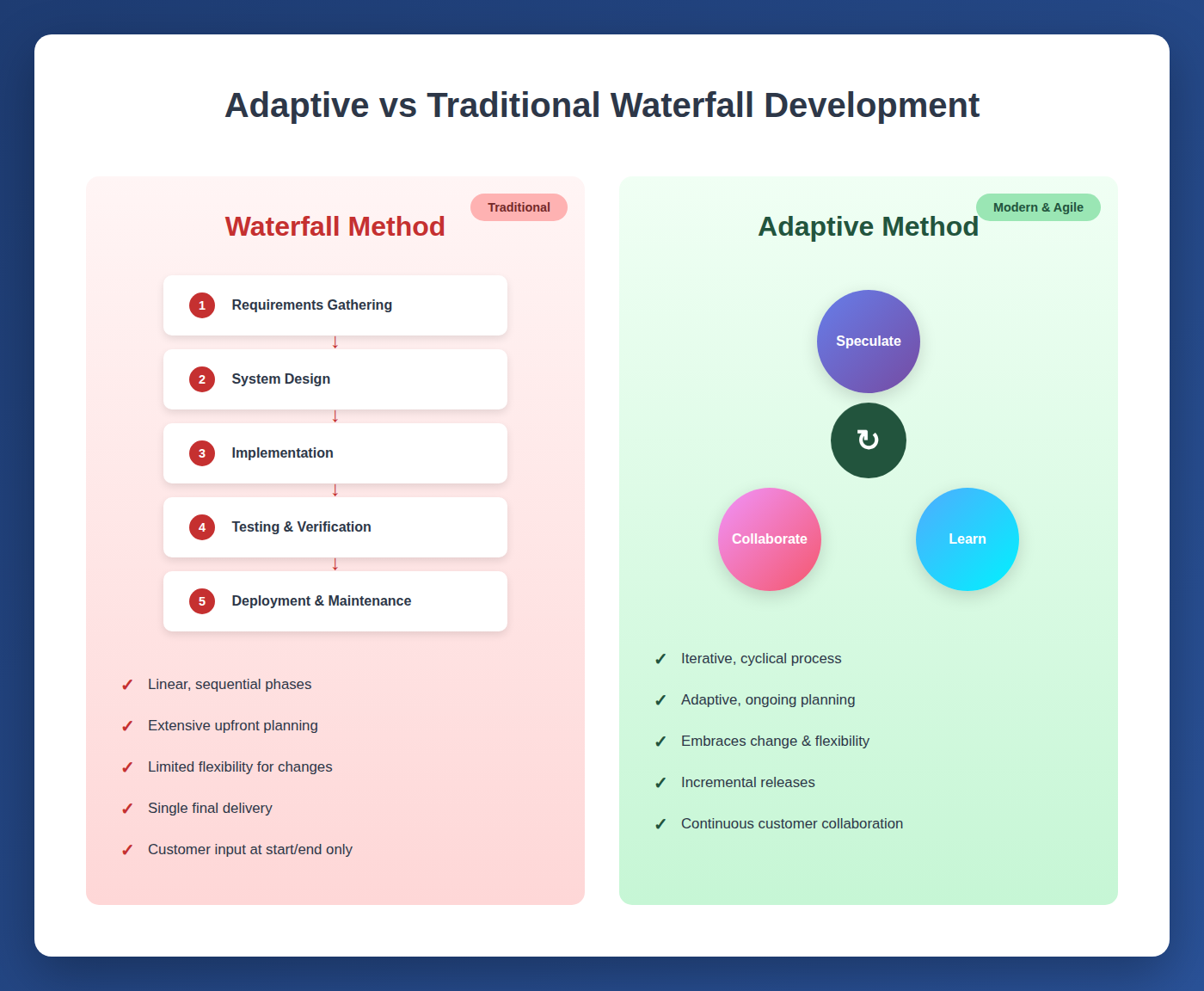
| Aspect | Adaptive Software Development | Traditional Waterfall |
|---|---|---|
| Planning | Continuous, adaptive planning | Comprehensive upfront planning |
| Change | Welcomed and expected | Managed through formal change control |
| Customer Involvement | Continuous throughout project | Primarily at beginning and end |
| Delivery | Incremental, iterative releases | Single final delivery |
| Risk Management | Continuous through iterations | Front-loaded risk analysis |
| Documentation | Just enough to support collaboration | Comprehensive documentation |
Neither approach is universally superior. However, for most modern app development projects—particularly those involving uncertainty, innovation, or rapidly changing requirements—adaptive approaches deliver better outcomes.
Implementing Adaptive Software Development: Practical Steps
Organizations interested in adopting ASD should approach the transition thoughtfully:
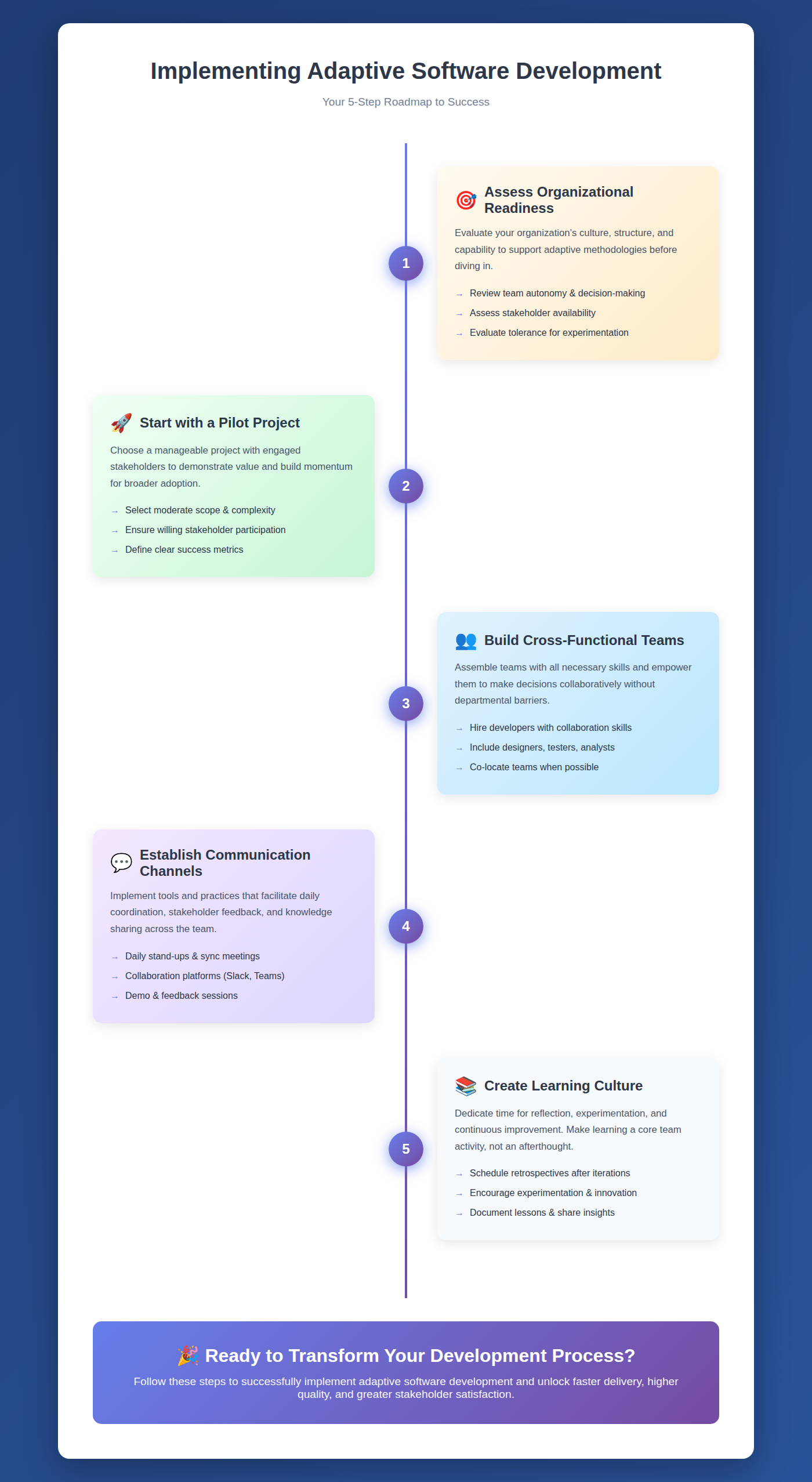
1. Assess Organizational Readiness
Adaptive methodologies require cultural shifts. Evaluate whether your organization can support:
- Empowered, self-organizing teams
- Regular stakeholder collaboration
- Tolerance for uncertainty and experimentation
- Investment in continuous learning
2. Start Small
Don’t attempt to transform your entire organization overnight. Select a pilot project that:
- Has manageable scope and complexity
- Involves stakeholders willing to engage actively
- Won’t create catastrophic consequences if it encounters difficulties
3. Build Cross-Functional Teams
Assemble teams with all necessary skills. When you hire developers, designers, testers, and other specialists, ensure they can work collaboratively rather than in isolated departments.
4. Establish Clear Communication Channels
Effective collaboration requires infrastructure. Implement tools and practices that support:
- Daily team coordination
- Stakeholder demonstrations and feedback
- Knowledge sharing and documentation
- Issue tracking and resolution
5. Focus on Learning
Create explicit time and space for learning activities. Teams need permission to reflect, experiment, and adjust their approaches without fear of being perceived as inefficient.
Common Challenges and How to Overcome Them
Organizations implementing adaptive software development often encounter predictable obstacles:
Resistance to Change
People comfortable with traditional approaches may resist new methodologies. Address this through education, demonstrating benefits with pilot projects, and involving skeptics in the transition process.
Stakeholder Availability
ASD requires active stakeholder participation throughout the project. If stakeholders can’t commit the necessary time, establish clear proxy decision-makers who can engage regularly.
Scope Management
The flexibility to adapt can sometimes lead to scope creep. Maintain discipline through time-boxed iterations and clear prioritization of features based on value delivered.
Documentation Concerns
Some organizations worry that adaptive approaches produce insufficient documentation. Define what documentation truly adds value and create just enough to support future maintenance and compliance needs.
The Future of Adaptive Software Development
Adaptive methodologies continue evolving to address emerging challenges:
Integration with DevOps
The combination of adaptive development and DevOps practices creates powerful continuous delivery capabilities. Organizations increasingly view these as complementary approaches rather than separate initiatives.
AI-Assisted Development
Artificial intelligence tools are beginning to support adaptive workflows by automating repetitive tasks, suggesting optimizations, and analyzing patterns in project data to inform decision-making.
Remote and Distributed Teams
The shift toward remote work has prompted innovations in how distributed teams collaborate adaptively. New tools and practices support effective adaptive software development across time zones and geographies.
Scaled Adaptive Frameworks
While ASD originated for smaller projects, frameworks like SAFe (Scaled Agile Framework) extend adaptive principles to large, complex initiatives involving multiple teams and dependencies.
Frequently Asked Questions
Q: Is adaptive software development the same as Agile?
Adaptive Software Development is a specific agile methodology, one of several approaches that fall under the broader agile umbrella. While ASD shares core agile values—prioritizing individuals and interactions, working software, customer collaboration, and responding to change—it has distinct characteristics, particularly its three-phase lifecycle and emphasis on speculation and learning over traditional planning.
Q: What types of projects are best suited for adaptive software development?
ASD works particularly well for projects with significant uncertainty, evolving requirements, or innovative elements. This includes new product development, projects in rapidly changing markets, and initiatives where user needs aren’t fully understood upfront. It’s less suitable for projects with fixed, well-understood requirements, strict regulatory constraints requiring extensive documentation, or situations where stakeholders cannot commit to active ongoing participation.
Q: How do you measure success in adaptive software development?
Success metrics in ASD focus on delivered value rather than adherence to original plans. Key indicators include customer satisfaction scores, frequency of releases, defect rates in production, team velocity over time, and business outcomes like revenue generated or costs saved. The best measures align with actual business objectives rather than traditional metrics like on-time/on-budget delivery against initial estimates.
Q: Can adaptive software development work for large enterprise projects?
Yes, though it requires adaptation. Large enterprises often use scaled frameworks that apply adaptive principles across multiple teams. Success factors include strong architectural guidance to ensure coherent integration, clear governance structures for cross-team coordination, executive sponsorship to support the cultural changes required, and investment in the infrastructure needed to support collaboration at scale.
Q: How long should adaptive software development iterations be?
Most ASD implementations use iterations (time-boxes) of 4-8 weeks. Shorter iterations provide more frequent feedback and adaptation opportunities but require more overhead for planning and review. Longer iterations allow teams to tackle more complex features but reduce flexibility. The optimal length depends on your specific context—project complexity, team maturity, stakeholder availability, and the pace of change in your market.
Conclusion: Embracing Adaptive Approaches for Competitive Advantage
Understanding what adaptive software development is represents just the first step. The real value comes from implementing these principles to build better software faster and with greater alignment to actual business needs.
In an era where change is the only constant, organizations that embrace adaptive methodologies position themselves to respond effectively to whatever challenges and opportunities emerge. Whether you’re launching a new app development initiative, upgrading existing systems, or transforming how your organization delivers software, adaptive approaches provide the flexibility and responsiveness modern markets demand.
The companies thriving today aren’t those with the most detailed plans—they’re the ones that learn fastest, adapt most effectively, and deliver value continuously. Adaptive software development provides the framework to become that kind of organization.
Ready to transform how your team builds software? Start with one project, embrace the adaptive mindset, and experience firsthand how this methodology can accelerate delivery, improve quality, and increase stakeholder satisfaction.
