


Finding the right web development partner in the USA can make or break your digital presence. Whether you’re launching your first website or redesigning an existing platform, choosing an agency that aligns with your vision, budget, and technical requirements is crucial for success.
In this article, we evaluate 9 of the best web development agencies. Each has been chosen based on successful projects, happy clients, and proven results.
When searching for your ideal web development partner, consider your specific vision, budget, and technical requirements to find the best fit for your company.
Global Market About Web Development
The web development industry is experiencing remarkable growth as businesses worldwide recognize the necessity of strong digital presence. The market is valued at approximately $82.4 billion in 2026 and is projected to reach $165.13 billion by 2035, demonstrating the increasing investment companies are making in their online platforms.
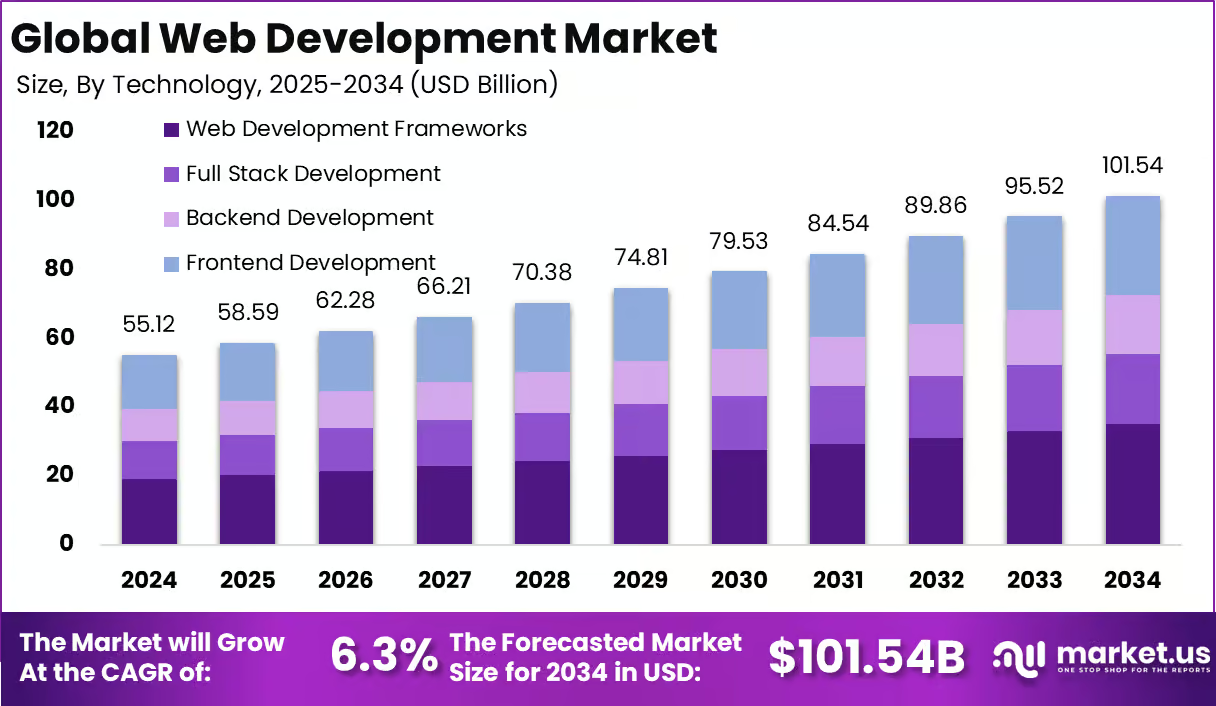
Several factors drive this expansion. Over 60% of businesses are increasing their digital investments to enhance customer engagement and strengthen their brand presence. The surge in e-commerce, combined with widespread smartphone adoption and affordable internet access, has made professional web development services essential rather than optional.
Mobile devices now account for the majority of web traffic, creating demand for responsive, fast-loading websites that deliver seamless experiences across all devices. Companies recognize that their website often serves as the first impression for potential customers, making quality web development a direct investment in revenue growth.
What Is a Web Development Agency?
A web development agency is a professional service provider specializing in creating, maintaining, and optimizing websites and web applications. These agencies employ teams of designers, developers, project managers, and strategists who collaborate to build digital solutions that meet specific business objectives.

Unlike freelance developers or in-house teams, agencies offer comprehensive capabilities spanning multiple disciplines. They handle everything from initial strategy and design through development, testing, launch, and ongoing maintenance. This full-service approach ensures consistency throughout the project lifecycle and provides clients with a single point of contact for all their web development needs.
Modern web development agencies go beyond basic website creation. They integrate advanced technologies like artificial intelligence, implement conversion optimization strategies, ensure mobile responsiveness, optimize for search engines, and build scalable platforms that grow with your business. Many agencies also provide complementary services including digital marketing, branding, and ongoing technical support.
Types of Web Development Agencies
The web development landscape includes several specialized agency types, each serving different needs and industries.
- Full-Service Digital Agencies offer end-to-end solutions covering web development, design, marketing, branding, and strategy. These agencies work best for businesses seeking a comprehensive partner who can handle multiple aspects of their digital presence under one roof.
- Specialized Web Development Shops focus primarily on technical implementation using specific frameworks or technologies. They excel at complex custom development projects requiring deep technical expertise in particular programming languages or platforms.
- E-commerce Development Agencies concentrate on building and optimizing online stores. They understand the unique requirements of e-commerce platforms, including payment processing, inventory management, shopping cart functionality, and conversion optimization strategies.
- Enterprise Development Agencies serve large organizations with complex requirements, legacy system integration needs, and multiple stakeholder groups. They offer robust project management, security compliance expertise, and scalability to handle high-traffic enterprise applications.
- Design-First Agencies prioritize user experience and visual design while maintaining strong development capabilities. These agencies suit brands where aesthetic appeal and user interface excellence are paramount to business success.
Who Should Hire a Web Development Agency?
Hiring a web development agency makes sense in several scenarios. Companies lacking in-house technical expertise benefit from accessing skilled professionals without the overhead of maintaining full-time development teams. Agencies bring experience across diverse projects and industries, offering insights and best practices that internal teams might miss.
Businesses facing tight deadlines often turn to agencies for their ability to scale resources quickly. An agency can assemble the right team size and skill mix to meet project timelines that would be impossible with limited internal resources.

Organizations undertaking complex projects requiring specialized skills find agencies valuable. Whether building e-commerce platforms, integrating third-party systems, implementing AI features, or developing custom web applications, agencies maintain expertise across various technologies and frameworks.
Companies wanting to focus on their core business activities appreciate agencies handling the technical complexities of web development. This allows internal teams to concentrate on business strategy, customer service, and operational excellence while experts manage the digital infrastructure.
Startups and growing businesses also benefit from agency partnerships. They gain access to enterprise-level expertise and capabilities at a fraction of the cost of building equivalent internal teams, allowing them to compete effectively with larger competitors.
Top Web App Development Agencies
1. LowCode Agency
LowCode Agency specializes in rapid application development using modern low-code and no-code platforms. They help businesses build custom web applications significantly faster than traditional development approaches, reducing time-to-market while maintaining quality and functionality.
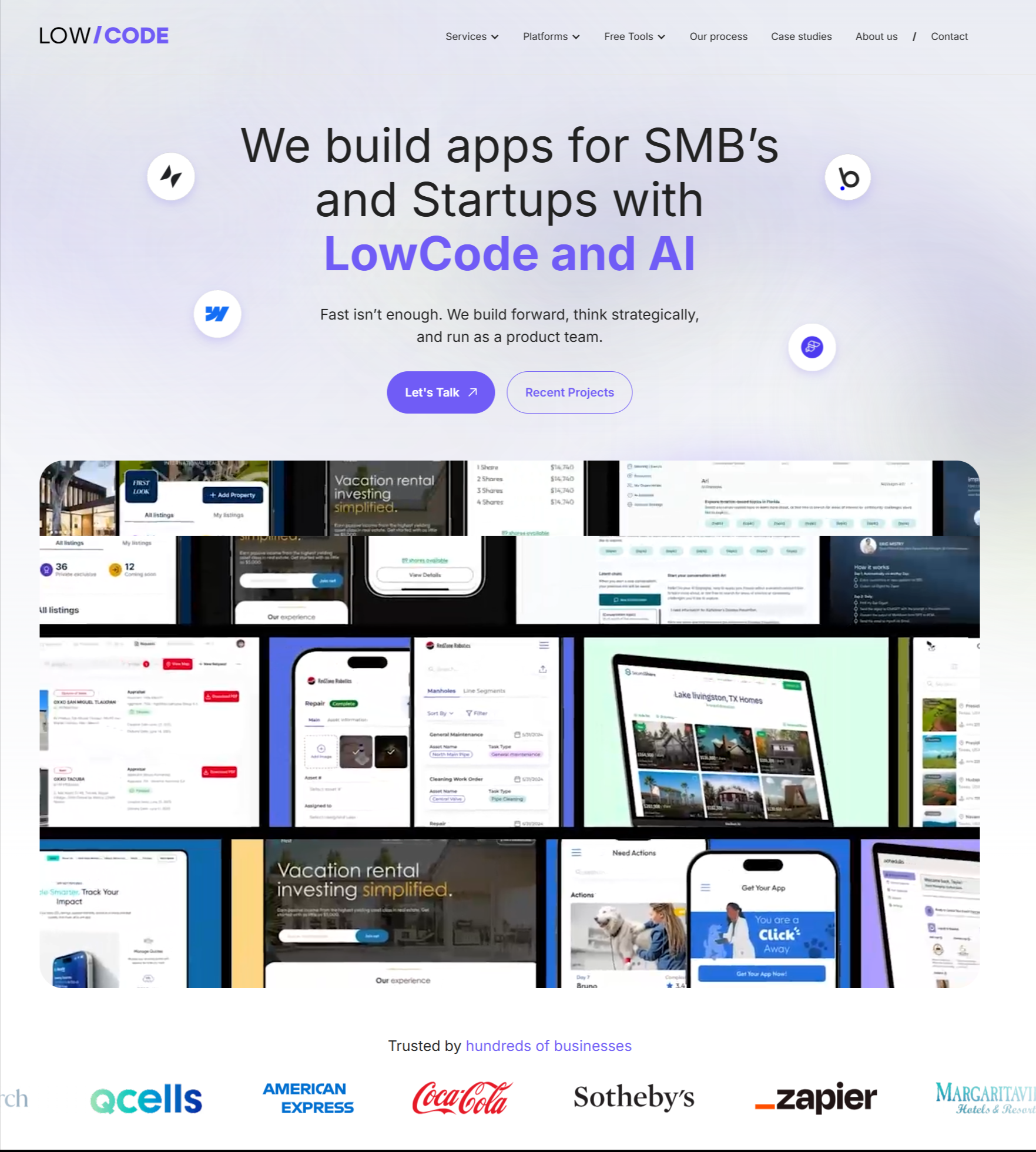
Their expertise spans multiple low-code platforms, allowing them to recommend the best solution for each client’s specific requirements. The agency excels at building internal business tools, customer portals, database applications, and workflow automation systems that typically require months to develop using conventional methods.
LowCode Agency serves businesses looking to digitize processes quickly without extensive development budgets. Their approach combines visual development tools with custom coding when necessary, delivering applications that are both powerful and maintainable. They also provide training to help clients manage and modify their applications independently after launch.
2. ThoughtBot
ThoughtBot has built a strong reputation for product design and development services. Founded on principles of agile development and design thinking, they work with startups and enterprises to transform ideas into successful digital products.
The agency follows a collaborative approach, working closely with clients throughout the entire product lifecycle. Their team includes designers, developers, and product strategists who use proven methodologies to validate ideas, design user experiences, build applications, and refine products based on real user feedback.

ThoughtBot’s portfolio includes work across various industries, from healthcare and finance to education and consumer technology. They specialize in Ruby on Rails, React, and mobile development, bringing deep technical expertise to complex projects. Their emphasis on testing, code quality, and sustainable development practices ensures long-term product success.
3. DockYard
DockYard positions itself as a digital product agency with particular strength in progressive web applications and modern JavaScript frameworks. They combine design strategy with engineering excellence to create innovative web experiences.
The agency’s technical focus centers on Ember.js and Elixir/Phoenix, making them ideal for projects requiring real-time functionality, scalability, and complex interactive features. Their design team works in parallel with developers, ensuring seamless integration between visual design and technical implementation.
DockYard serves clients ranging from startups to Fortune 500 companies. They excel at projects where performance, user experience, and technical sophistication are critical success factors. Their process emphasizes research, prototyping, and iterative refinement to deliver products that meet both user needs and business objectives.
4. 10up
10up specializes in enterprise-level WordPress development and digital publishing solutions. They work with major media companies, universities, and large organizations requiring robust content management capabilities at scale.
The agency’s expertise extends beyond standard WordPress implementation. They build custom themes, plugins, and integrations that handle millions of visitors while maintaining performance and security. Their team includes specialists in accessibility, ensuring websites meet WCAG compliance standards.
10up’s distributed team spans multiple time zones, allowing them to serve global clients effectively. They emphasize open-source contributions, documentation, and knowledge sharing within the WordPress community. Their work combines technical excellence with strategic consulting to help organizations maximize their content management investments.
5. Cyber-Duck
Cyber-Duck is a user experience agency that brings together design research, information architecture, and development expertise. Based in the United Kingdom, they serve clients across Europe and internationally.
The agency takes a research-driven approach to every project, beginning with thorough user research and competitive analysis. This foundation informs their design decisions, ensuring solutions address real user needs rather than assumptions. Their development team builds responsive websites and applications using modern frameworks and best practices.
Cyber-Duck works across sectors including education, healthcare, finance, and professional services. They excel at projects where user experience quality directly impacts business outcomes, such as lead generation websites, service portals, and e-commerce platforms. Their process includes comprehensive testing and optimization to maximize conversion rates and user satisfaction.
6. Netguru
Netguru stands out among web development agencies through its full product ownership approach, serving as strategic collaborators throughout the entire development lifecycle. The Poland-based agency has grown into a global player with expertise spanning web development, mobile applications, and digital product consulting.
Their technical capabilities cover modern frameworks including React, Vue.js, Node.js, and Ruby on Rails. Netguru follows agile methodologies, organizing work into sprints that deliver consistent progress and maintain flexibility as projects evolve. This approach allows them to adapt quickly to changing requirements while keeping stakeholders informed.
The agency has developed particular expertise in fintech and SaaS development, though they serve clients across diverse industries including healthcare, real estate, and media. Their portfolio demonstrates capability in building complex platforms that handle sensitive data, process transactions, and scale to serve millions of users.
7. Frog (formerly FrogDesign)
Frog brings decades of design thinking and innovation to web development projects. Originally known as FrogDesign, this legendary agency has influenced digital product design globally through their human-centered approach and creative vision.
The agency operates at the intersection of design, technology, and strategy. Their teams include designers, engineers, researchers, and business strategists who collaborate to solve complex problems. Frog works primarily with large enterprises and organizations tackling ambitious digital transformation initiatives.
Their web development work emphasizes innovation and differentiation. Rather than following standard templates or patterns, Frog creates custom solutions that reflect each client’s unique brand and value proposition. They excel at projects where creative excellence and technical sophistication must coexist, producing experiences that are both visually striking and functionally robust.
8. Big Drop Inc
Big Drop Inc operates as a full-service digital agency with strong capabilities across branding, web development, marketing, and mobile applications. Based in New York with offices in multiple cities, they serve clients ranging from startups to established corporations.
The agency’s web development practice emphasizes custom solutions tailored to specific business goals. They build websites using various content management systems and custom frameworks, selecting the appropriate technology stack based on project requirements rather than following a one-size-fits-all approach.
Big Drop Inc distinguishes itself through integrated service delivery. Their developers work alongside brand strategists, designers, and marketers to ensure technical implementation supports broader business objectives. This collaborative model helps clients achieve consistency across all digital touchpoints while maintaining technical excellence in web development.
9. Dom & Tom
Dom & Tom specializes in building digital products that combine mobile applications with web platforms. Their expertise spans the complete product development lifecycle, from initial concept through launch and ongoing optimization.
The agency takes a product-thinking approach to web development, focusing on user needs and business outcomes rather than just technical specifications. Their teams include product managers who help clients define requirements, prioritize features, and make strategic decisions throughout development.
Dom & Tom’s technical expertise covers modern web frameworks, cloud infrastructure, and API development. They excel at building platforms that integrate multiple systems, handle complex business logic, and scale to support growing user bases. Their work spans industries including healthcare, finance, logistics, and consumer technology.
How to Choose the Right Web Development Agency
Selecting the right agency requires careful evaluation across multiple dimensions. Start by clearly defining your project requirements, budget constraints, and timeline expectations. This clarity helps you identify agencies with relevant experience and appropriate capabilities.
Review agency portfolios thoroughly, looking for projects similar in scope and complexity to yours. Pay attention to the industries they serve, technologies they use, and results they’ve achieved for clients. Strong portfolios demonstrate not just aesthetic quality but also functional excellence and business impact.
Assess technical expertise by asking specific questions about their development approach, technology stack, testing procedures, and quality assurance processes. Understand how they handle security, performance optimization, and scalability. Agencies should clearly explain their technical decisions in business terms you can understand.
Evaluate communication and project management capabilities. Successful web development requires consistent collaboration between your team and the agency. Ask about their communication tools, meeting cadence, reporting processes, and how they handle changes or unexpected challenges.
Check references and reviews from past clients. Independent review platforms provide valuable insights into agency reliability, communication quality, and ability to deliver on promises. Speaking directly with references allows you to ask specific questions about their experience working with the agency.
Consider cultural fit and values alignment. You’ll work closely with your chosen agency for weeks or months. Ensure their work style, communication approach, and values mesh well with your organization’s culture and expectations.
Compare pricing models and contract terms. Some agencies charge fixed project fees while others use time-and-materials billing. Understand what’s included in their pricing, how they handle scope changes, and what ongoing support they offer after launch.
Common Mistakes to Avoid When Hiring a Web Development Agency
Choosing based solely on price often leads to disappointing results. While budget matters, the cheapest option rarely delivers the quality, expertise, or support needed for successful projects. Focus on value rather than lowest cost, considering the long-term implications of your decision.
Failing to verify technical expertise creates risk. Some agencies present impressive portfolios featuring work done by others or exaggerating their role in projects. Request detailed information about their involvement, technologies used, and specific contributions to showcase projects.
Neglecting to establish clear communication protocols causes confusion and delays. Define expectations upfront regarding response times, reporting frequency, meeting schedules, and escalation procedures. Ambiguity in communication leads to misunderstandings that derail projects.
Skipping the contract review process exposes you to potential issues. Ensure contracts clearly define scope, deliverables, timelines, payment terms, intellectual property rights, and procedures for handling disputes or changes. Vague agreements create problems when disagreements arise.
Overlooking post-launch support needs is shortsighted. Websites require ongoing maintenance, security updates, and technical support. Understand what support the agency provides after launch, whether included in the initial price or available through separate maintenance agreements.
Ignoring agency capacity and availability causes delays. Some agencies overcommit, leaving your project understaffed or deprioritized. Ask about their current workload, team availability, and how they allocate resources across concurrent projects.
Failing to define success metrics makes evaluating results impossible. Establish clear goals and key performance indicators upfront. Whether measuring traffic, conversions, page load speed, or user engagement, defined metrics enable objective assessment of project success.
Why More Teams Are Choosing No-Code for Web Development
No-code platforms are transforming how organizations approach web development. These visual development tools allow users to build functional websites and applications without writing traditional code, democratizing web development beyond technical specialists.
Speed represents the primary advantage of no-code solutions. What might take months using traditional development can often be accomplished in weeks or even days with no-code platforms. This rapid development cycle enables businesses to test ideas quickly, launch minimum viable products, and iterate based on real user feedback.
Cost efficiency drives no-code adoption, particularly among startups and small businesses. Building websites with no-code tools requires significantly less financial investment than hiring developers or engaging agencies. Organizations can allocate budget to other priorities while still establishing professional online presence.
Flexibility appeals to businesses needing to make frequent changes. No-code platforms empower non-technical team members to update content, modify layouts, and adjust functionality without depending on developers. This independence accelerates decision-making and reduces bottlenecks.
Lower technical barriers enable innovation. Marketing teams can build landing pages, operations teams can create internal tools, and customer service teams can develop help centers without waiting for IT resources. This democratization unleashes creativity across organizations.
No-code platforms continue advancing in capability, now handling complex use cases previously requiring custom development. Modern no-code tools support database integration, API connections, user authentication, payment processing, and sophisticated business logic.
However, no-code solutions have limitations. Highly complex applications with unique requirements still benefit from custom development. No-code platforms sometimes impose constraints on design customization, performance optimization, or specific functionality. Understanding these tradeoffs helps organizations make informed decisions about when no-code makes sense versus when traditional development is necessary.
Final Thoughts
Choosing the right web development agency significantly impacts your digital success. The agencies featured in this guide represent diverse approaches, specializations, and capabilities, ensuring options exist for virtually any project type or industry.
Success in web development extends beyond technical execution. It requires strategic thinking, user-centered design, quality assurance, and ongoing optimization. The best agencies bring all these elements together, serving as true partners in your digital journey rather than just vendors delivering specifications.
Take time to evaluate options thoroughly. Clear requirements, careful vetting, and realistic expectations set the foundation for successful agency partnerships. Whether you choose a specialized technical shop, a full-service digital agency, or explore no-code alternatives, the right partner will help you achieve your online objectives and drive real business results.
The web development landscape will continue evolving with new technologies, frameworks, and approaches emerging regularly. Partner with agencies that demonstrate commitment to learning, adaptation, and delivering value beyond just building websites. Your digital presence is too important to leave to chance—invest in expertise that propels your business forward.